Sunday, 13 February 2022

Hyenas Have the Last Laugh

Image source

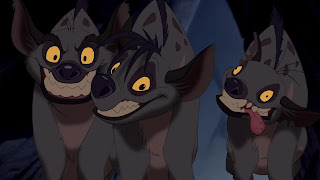
I recall the trio of hyenas from childhood viewings of The Lion King, three squawking, slobbering brutes, greedily desiring an endless supply of prey from Pride Lands, foolishly believing Scar would actually grant it to them. When, if ever, you envision hyenas, the image in your mind probably isn’t much prettier; you’re more likely to imagine them as cunning, avaricious or outright evil.

More than just skulls and bones

It may surprise you to know that real hyenas are nothing like their modern media counterparts. In fact, these mammals aren’t even dyed-in-the-wool scavengers! Spotted hyenas, the most common of the four major hyena species (the others being striped, brown and aardwolf), are known to scavenge for food. But what most of us don’t realise is that they are also prolific hunters, with a higher success rate than the mighty lion. Perhaps the most shocking revelation of all is that lions are known to steal more kills from hyenas than vice-versa! As packs, hyenas hunt antelopes, wildebeests and zebras, killing the majority of their prey themselves.

This proficiency may be attributed in part to their intelligence, which is just one of their natural advantages. Evidence of this intellect lies in their remarkable teamwork. An experiment conducted at Duke University showed that hyenas work better together than the brainy chimpanzees themselves, outperforming these primates on a cooperative problem-solving test.

To gain further insight into their minds, I spoke to Lakshmi Natarajan, who has been volunteering at the Zoo Zurich for the last 15 years and working with hyenas for two. “I feel like a hyena ambassador sometimes,” she jokes as she introduces herself. “Of all the animals we have in the zoo, hyenas are the most misunderstood.” She shares how hyenas are “challenging species to have in zoos” as they “get bored quite easily”. To keep animals active and mentally healthy, the Zoo Zurich uses behavioural enrichment exercises. With hyenas, this involves concealing meat in jute sacks and hanging them up on trees for the clever creatures to sniff out.

Are hyenas the OG feminists?

Another sign of their smarts is the hyenas’ complex social behaviour. Hyenas are one of the few species that live in matriarchal societies. A group of hyenas, also known as a cackle, can consist of any number from six to 100 members. “The hierarchy is extremely strict,” Lakshmi tells me, with a dominant matriarch who decides everything from feeding timings to defence strategies; and every other female in a rigid order below her. When born, a female takes her place in society based on her mother’s ranking. “What about the males?” I wonder. “They don’t play a permanent role in the hierarchy,” Lakshmi replies. They live “on the periphery of the group” and often move to another clan at about two years of age. Therefore, the highest-ranking male in a cackle is often subordinate to its lowest-ranking female.

Female spotted hyenas are also physically larger than, and possess as much testosterone as their male counterparts. Some zoologists believe that their high levels of this hormone is what leads to an astonishing biological phenomenon: a female hyena’s pseudophallus. Yup, you read that right! Female hyenas have genitalia that is so elongated that it looks - and in some cases behaves - like a phallus. The urogenital canal running through this appendage allows it to perform urination, copulation and even be used as a birth canal. Additionally, it “prevents any forcible copulation,” Lakshmi shares, so the female chooses whether and when to mate.

But hyenas aren’t just cool creatures for us to gawk at. They are, according to Lakshmi, “absolutely essential for the ecosystem”. Hyenas consume their kills (and occasionally those of other animals) bones and all, recycling the carrion and keeping the environment clean. If not for them, several ecosystems would be filthy, rancid and rich with disease.

Busting myths

So why is it that we view hyenas as unnecessary at best, and as base, cowardly nuisances at worst? This disdain may originate from the uniquely human fear of the unknown, or xenophobia. Hyenas, with their awkwardly proportioned limbs covered in scruffy greyish-brown fur, do not appeal to us visually. Add to that their propensity to chew and digest bones directly and the females’ extraordinary pseudophalli, and they’re pretty much monsters in our eyes.

Widely considered hybrids, hyenas were excluded from the Noah’s Ark in The History of the World by Sir Walter Raleigh, who explained his belief that god would only save the “purely bred”. Ernest Hemingway, in his novel The Green Hills of Africa, described the animal as a “hermaphroditic self-eating devourer of the dead, trailer of calving cows, ham-stringer, potential biter-off of your face at night while you slept, sad yowler, camp-follower, stinking, foul, with jaws that crack the bones the lion leaves”. This notion continues unto today, when proverbs like “hyenas come with merry smiles” warning people against hypocrites are a part of our vernacular.

Why should we care?

As CNN host Brianna Keilar once said, “misinformation is a virus unto itself”. And as this virus spreads, it is hurting hyenas. People of many cultures despise hyenas, and this hatred has manifested as persecution. The striped hyena, found in Africa and Asia, is classified as Near Threatened by International Union for Conservation of Nature. The spotted hyena, brown hyena and aardwolf, meanwhile, occur naturally only in Africa. Even in this continent, Lakshmi states, violence against hyenas is common. For example, meat laced with poison is laid out to trap hyenas that venture near human territory. They are “not animals that people want to conserve,” she explains, and so even as their space is encroached upon, even as they lose their habitats, even as they are poisoned to death, there is scarcely any effort taken to save them.

It’s time to spread the word: hyenas aren’t the cruel cackling crooks you think they are. Because, to paraphrase and, in the process, absolutely butcher an old proverb: until the hyenas have their historians, tales of wildlife shall always glorify the lions.

Thursday, 6 January 2022

The Beginning of the End: Part 2

This post is a continuation of my story, The Beginning of the End. To read Part 1, click here.

Image source

“Me? Babe, I’m a twenty-two year old with no money, no home, and until last week, no job. How exactly do you expect me to get rid of this pandemic for you?”

“Scientists have traced the origins of the virus to Wuhan, to a certain virology institute in the city. Can you guess which one I’m talking about?”

“No, no, no,” I shook my head resolutely as soon as it dawned on me. “Tomorrow’s just my first day there; I can’t do something stupid to jeopardise my career immediately. And what if this is all some scam to ruin the institue? It was fine when you were just telling this elaborate tale, but now you want me to put my job at risk-”

“On the street perpendicular to this one is a bungalow with a shingled blue roof. Inside it sleeps my past self, myself from your timeline. I can take you there right away, or you can visit tomorrow before work, and see her for yourself. Furthermore, I’m willing to wait here for you until tomorrow evening; you can even tie me up to ensure that I don’t leave. Is that proof enough that this isn’t a scam?”

“I suppose,” I grumbled, “but I’m still not agreeing to anything until you clarify what you want me to do and how it’ll ‘change the course of destiny’ or whatever. Oh, and how I can carry it out without, you know, losing the one lifeline I’ve been granted through this job.”

“When you arrive at the institue tomorrow, you will be shown to a desk in a hall of shared cubicles on the second floor. At the end of the hall is an elevator. At 1 o’clock, most of the staff on your floor will begin eating their lunch, some using the elevator to visit friends on other levels. This is when you can go up to the fifth floor. Upon exiting the elevator, you will see ahead of you a long, narrow corridor. Put on a pair of gloves. The second door on the right leads to a room containing the earliest form of the SARS-CoV-2 in a glass dome. The panel beneath this dome has a series of buttons. All you have to do is press the one labelled “contain”. When it asks you to enter a password, type in the code 1-3-a-c. This will seal the container and make it impenetrable. Anyone who tries to open it won’t succeed without damaging its contents in the process. Basically, it’ll be impossible for the virus to escape into the outside world. Once you’ve guaranteed this, get back to work and keep your head down. You can report to me at the end of the workday.”

“I need some time to think about it,” I murmured. “This is all just… too much handle.”

“Perhaps this will give you some incentive to save the entire human race.” She replied contemptuously, plucking a fat wad of bills from her pocket. “300, 000 dollars. You won’t have to worry about finances for a while.”

I contemplated the money, nearly convinced. “I have one last question.”

“Go on,” she exhaled.

“In the future, where am I? Do you know me? Am I happy?”

“You’re in Beijing. You’ve got a stable career, a golden retriever, a broad circle of friends. But, no, I wouldn’t say you’re happy. You see, your mother passed away during the second COVID wave, and you haven’t been truly happy since.”

...

“Good morning!” I called to my new neighbour, Mrs Zhang, as I skipped out onto the street, cup of coffee in hand, for a breath of crisp, wintry air.

It had been a week since Diya’s visit, and my life had taken a dramatic turn for the better. 300, 000 USD was more than triple my total debt, which I had already begun to pay off; in small increments, so as to not raise suspicion. I’d moved out of the cramped one-bedroom and into a nicer place uptown with a lounge and an open kitchen and a balcony chockfull of flowers and herbs. My personality had transformed, too, after completing my mission. Once consumed with self-doubt and regret, I’d learnt to be proud, to love myself wholly and deeply. I mean, which other person could boast that they had, almost single-handedly, saved the world? I looked with excitement towards the future I had safeguarded.

I lifted the coffee to my lips, ready to taste the rich bitterness of the bean blended with the creamy sweetness of the milk. As the liquid flowed into my mouth and down my throat, though, it was flavourless. I frowned, sniffing at the rim of the cup; I could hardly detect a scent, either. Hardly had I swallowed a second sip when the first fit of coughs began.

Oh, Diya, I thought to myself, as a ripple of dread washed over me, you didn’t think to take a COVID test before meeting me, did you?

The heroes who had arrived from the future, in a blaze of glory, to deliver the human race from the pandemic, had only brought it to us sooner. They say you meet your destiny on the road you take to avoid it. They’re right.

Saturday, 1 January 2022

The Beginning of the End

“Remember: if you need anything, I’m just a phone call away!”

With that, the decrepit old landlady shuffled away, leaving me alone in the austere apartment I would call home for the foreseeable future. I collapsed onto a rickety, three-legged stool - the only piece of furniture in the vicinity - only for it to promptly give way, sending me toppling to the ground in a jumble of gangly limbs and cacophonous swearing. God, did I miss London.

I’d spent the four happiest years of my life studying virology at the Imperial College of London, expecting to stay and teach the same to fellow microbiology enthusiasts someday. Unfortunately, beating hundreds of my exam-acing, interview-nailing peers to a teaching post was easier said than done. Two weeks after my Visa expired, in September 2019, I arrived in Wuhan, homeless, unemployed and mourning for a version of me that had never existed, and now, never would.

But they say that when one door closes, another opens, and it wasn’t long before I came across an advertisement for an entry-level position at the Wuhan Institute of Virology. Sure, it was a far cry from a professorial career in a prestigious foreign university, but as long as it paid the bills and kept me from starvation, it’d have to do for now. With that in mind, I rose, intending to head straight to bed; I didn’t want to sleepwalk through my very first day of work.

Apparently some supreme being had it out for me and had decided to add a lack of sleep to my already lengthy list of vexations, though, because soon as I began to drift off, I was roused again by the ear-splitting shriek of a decades-old doorbell.

Rubbing sleep from my eyes, I opened the door to a petite figure wrapped in an ankle-length overcoat, a nondescript baseball cap tilted over their eyes.

“Uh… who are you?” I asked, too perplexed to bother with politeness. Their reply came in the form of an identity card, extended towards me in a gloved hand. Scanning through it, I had barely discerned their name and address when something strange caught my eye: a minuscule inscription in the top right corner of the card, claiming that it had been printed in 2025, or six years from today.

“Well, this is clearly fake,” I said, tossing it back to the intruder. I turned, and made to shut the door, when they finally spoke.

“Please let me in.” Their voice was soft yet steady. “I’ll explain everything as soon as you do so.”

“And I’ll do so as soon as you tell me whom you really are.”

The stranger sighed frustratedly, then plunged their hand back into the depths of their coat, only this time, drawing out a syringe. Before I could dodge, or snatch the instrument from them, or even holler for help, I felt a sharp sting on my upper arm. A moment of realisation, a bleat of alarm, a wave of numbness, and everything went black.

...

I came to in my living room, my hands and legs tied together with thick, unyielding ropes of twine. I tried to scream, but my exclamation was muffled into a mere whisper by the surgical mask covering my mouth.

“Relax.” I lifted my eyes to my captor, who was now pacing back and forth before me. “I’m not going to harm you in any way. I would release you, if I wasn’t sure you would try to escape or attack me immediately.”

“What do you want?” I groaned, though it came out sounding more like “waf joo oo wam?”

Somehow, they seemed to comprehend my words, because they responded simply, “to speak to you.”

With that, they shrugged off their coat to reveal an equally nondescript t-shirt and trousers, and crouched in front of me, resting their chin on their right palm. “First things first, let me introduce myself. I am, in fact, the Diya Khanna from the ID card I showed you. Another truth, though perhaps a less believable one, is that I live in the year 2025.”

I rolled my eyes and scoffed, no longer afraid of this stranger in my flat; after all, if she were planning to hurt me, wouldn’t she have done so by now? Besides, realising that she was a woman, a young, Asian one at that, provided some comfort to my disoriented mind.

“Look,” she exclaimed frustratedly, once again revealing the impatient nature beneath her otherwise detached demeanour, “I know that this is difficult to digest. I know that. But you have to open your mind and listen to me, because frankly, you don’t have any other option.”

Taking a deep breath, she continued, “time travel technology, an idea you’ve probably only been exposed to in works of fiction, has existed in the hands of the USA’s government since the early 2000s. While state scientists had run contained, risk-free tests with it, they agreed never to attempt to alter the past, fearing a major ripple effect that could turn the entire world on its head. In 2024, though, something happened that caused them to rethink this decision. Something so deadly that it ruined economies, overturned governments, annihilated entire populations. Something so terrible that any change in it, no matter how unexpected, could only be for the better. The seventh worldwide wave of the COVID-19 pandemic.”

...

“And that last vaccine, the one produced in 2022, that didn’t work either?”

“Technically, it worked, but only against the Omicron variant. The virus just mutated again and overcame it by the end of the year.”

As Diya narrated the horrors to come in the following six years, with sprinklings of statistics and spoonfuls of scientific evidence, I found myself trusting her against my own will. Eventually, she had loosened my mask, allowing me to voice my questions, which she answered as effortlessly as a practised virologist describing the basic structure of a cell.

She revealed how a virus had spread across China in December 2019, and reached every nook and cranny of the globe in mere months’ time. How it came in waves, tricking people into thinking it was gone during low tide and then returning during high tide to drown unsuspecting divers. How every precaution, every defence, every cure failed in the face of this mystifyingly murderous phenomenon. How the USA, after losing a tenth of its population, was forced to resort to means it had hoped never to even consider.

She showed me the letter she had received in mid-March in 2025, inviting her to a dinner party with a hand-picked collection of politicians, scholars and virologists, an NDA attached to the sheet. There, in a soundproof, windowless room in the White House’s West Wing, she had been covertly enlisted to join the force that would change the course of fate forever.

“But how does telling me all of this help?” I inquired, curious to finally hear how I’d gotten involved in this imbroglio.

“Well, before we arrived here, each of the nine travellers had a mission to fulfil. Mine was to find the person who could prevent this entire pandemic from occurring by a single action. And that person is you.”

Part 2 will be up on Friday, 7th January. Meanwhile, don't hesitate to leave a comment with your predictions on what happens next!

Saturday, 23 October 2021

Squid Game: What Makes it Special?

Since its release on 17th September, Squid Game has quickly become Netflix’s most watched series of all time. The show revolves around 456 people, each deeply in debt, who enter a tournament that promises them an escape from their financial struggle in the form of a cash prize of billions of won (Korean currency). What they don’t realise until the first round, however, is that the contest’s losers must pay a deadly price.

The concept of the show is fairly simple - every episode, the characters play a game. The few who win this game progress to the next round, until by the end, only a handful remain to claim the final prize. So why exactly is their story so appealing to such a broad range of audiences? How is it that in less than a month, Squid Game has gained 111 million viewers, beating fan favourites like Bridgerton, The Witcher, and Stranger Things to the top spot?

Disclaimer: This article contains spoilers for the first two episodes of Squid Game.

First of all, there’s the rather obvious aspect of the show’s spot-on commentary on capitalism. Like in The Hunger Games, the impoverished, underprivileged, and mistreated are forced to fight to their deaths, each of them merely a pawn in a game that the ultra-rich watch for entertainment. What sets Squid Game apart, though, is this simple fact: every one of the participants in these games makes a conscious choice to play them.

In signing consent forms, in voting, in staying in the competition even when offered a chance to leave, the contestants repeatedly choose to place themselves in immediate danger of grisly, gruesome deaths. The idea that hundreds of people would go through such torture just for a fleeting chance (ironically, a chance offered to them by the very perpetuators of the system that oppresses them) at a life of freedom from starvation, from debt, from all the evils of the capitalist economy, punches the viewer in the gut, awakening them to the incredible agony caused by the laissez-faire system. As reasoned by Arirang Meari, "Squid Game gained popularity because it exposes the reality of South Korean capitalist culture." While a North Korean state-run site may not be the most credible source around, this is still a point worth reflecting on!

Another unique and unexpected concept the series explores is that of equality. The characters in Squid Game have all faced extreme forms of inequality before entering the tournament. There’s Ali, who faces racial inequality. He migrates from Pakistan to South Korea hoping to secure a stable job, is exploited ruthlessly by his employer, and finds himself unable to feed his family. Then there’s Sang-Woo, who faces socio-economic inequality. After growing up in poverty, he briefly benefits off the capitalist regime, only to find himself drowning beneath its treacherous tides all over again.

The game’s organiser realises this, and even explains, “everyone is equal while they play this game. Here, the players get to play a fair game under the same conditions. Those people suffered from inequality and discrimination out in the world, and we’re giving them the last chance to fight fair and win.”

On the surface, this policy seems to ensure that all the players are equal in every sense. What it fails to take into account, though, is the fact that some players are already at a disadvantage due to overlooked factors. Both Sae-Byok and Ji-Yeong, being women and therefore physically weaker than the others, are excluded from multiple alliances and obliged to find their own means of survival. Similarly, Player 001 has the lower hand throughout the tournament simply due to his age, which slows down his mind and body. For these contestants to be equal to the others, they must first be granted additional benefits to compensate for those they naturally lack.

Here, Squid Game accurately and realistically demonstrates the difference between equality and equity, while keeping the theme subtle enough not to dominate the plot of a single episode.

The series also touches on universal human qualities, which are relatable to viewers across the globe. Dan Brown once wrote that “when they face desperation… human beings become animals.” This is true of the world’s entire population, including you and me, and Squid Game proves it time and time again.

While several pieces of media romanticise human desperation, this serial’s portrayal of the emotion is dark, dolorous and real. Contestants who start out as optimistic, idealistic, and generally good at heart become self-serving, immoral and inhumane. People who usually wouldn’t hurt a fly commit atrocities in the blink of an eye just for a minute increase in their chances of survival. By the end of the show, the characters have descended so far into depravity that they are barely recognisable as their original selves. Squid Game forces viewers to confront the darkest parts of themselves when they realise that they would make the same perverted choices as the players were they thrown into the same perverted circumstances.

Finally, despite all this, Squid Game’s perspective on humanity is not entirely cynical. At the very end of the series (minor spoilers ahead), Gi-Hun makes a final bet, this one on the inherent goodness of people. Just as the audience begins to lose faith in Gi-Hun’s belief that there is still some virtue in humankind, a single good deed proves him right after all. However bluntly, almost aggressively, the programme showcases humankind’s flaws, it leaves us with a message of assurance. That however dire circumstances may seem, there is always a chance that things will get better. The idea of hope, represented in various charcaters’ small yet significant acts of kindness throughout the series, is summarised succintly in this one scene.

Squid Game fascinates every one of us because it represents our everyday struggle for survival, albeit in an exaggerated, dramatised manner. It is a must-watch for everyone, from a casual Netflix enthusiast to a serious Marxist reformer.

Saturday, 16 October 2021

Prompt Writing: "The virus was born in Wuhan"

Disclaimer: The events of this story are entirely fictional. Any resemblance to real people, places or happenings is due to the author’s complete lack of originality.

The virus was born in Wuhan. There are theories about what caused it - a freak of nature, perhaps, or a virology experiment gone wrong - but no concrete proof has been found either way. Besides, we have far more pressing problems to deal with first. As I was saying, the virus was born in Wuhan, but it didn’t stay there forever. It spread, and it spread, and it spread, until it had reached every corner of China, from the beetle-frying, puppy-boiling kitchen of a popular restaurant in Beijing, to a store in Shanghai that sold fans and parasols made in Japan as exotic Chinese paraphernalia to unsuspecting tourists. Still, China’s government turned a blind eye to it, unhelpful and unsympathetic.

By the end of the year, the contagion had reached Spain, USA, India, more countries than I can venture to name. It was given the name COVID - CO for Corona, the virus’ family, VI for virus, and D for disease. Ignoring it was no longer an option. Instead, terms like “contact tracing” and “vaccine testing” began to jump out from every newspaper’s headline, the once-low demand for masks and sanitiser bottles shot through the roof, and a man in Uttar Pradesh made a fortune selling magical cow urine that, once swallowed, would supposedly grant its drinker immunity from the virus.

Despite thousands of statements to the contrary from brainy boffins across the globe, people persisted in believing that the threat was temporary, and would be gone in mere months’ time. They continued to live their lives as they pleased, sanitising their hands every now and then and wearing their masks below their chins and demanding of anyone who questioned them, “what’s the point in staying home when this virus will be gone in a couple of weeks anyway? Just chill out.”

Alas, those boffins were right. Before long, hospitals everywhere were filled to the brim with the infected, while the few and fortunate healthy stayed locked up at home, now too afraid to step out even to buy groceries. In Italy, deaths surpassed availability of graves by so much that rotting corpses lined the streets of every city. In the USA, President Trump announced 99% of COVID cases were “totally harmless” as people coughed to death three blocks away. And in North Korea, any civilian found infected with the virus, be they adult or child, was allegedly shot dead on the spot to prevent further diffusion. The entire world was in pandemonium.

When we had just about given up hope on our lives ever returning to normal, though, we discovered a ray of light at the end of the tunnel. A vaccine was released. 13 different vaccines, in fact, from the AstraZeneca’s sought-after Covishield to the Russian Federation’s Sputnik V, which might as well have been cow urine for the public’s lack of faith in it.

The rich were vaccinated first, of course. They carried out their own form of contact tracing, locating doctors and hospital owners and vaccine suppliers to beg of and borrow from and bribe. The middle class, too, were soon vaccinated by corporate, neighbourhood and government sponsored drives. Last came the poor, who gratefully accepted whichever cure was available to them, be it a sealed vial of Covishield or a random plastic box containing an unknown florescent liquid. Soon, there weren’t many who remained unvaccinated. There was the Texan Patrick Patriot, who refused to be injected with a serum that would supposedly make him autistic. There was the Tamilian Shailaja Swami, who had heard from her neighbour that the vaccines were made in China, “just like every other piece of kuppai in this world,” and would probably be the death of them all. There was the British Con Spirator, who declared to anybody who wanted to listen - and even those who didn’t - that Bill Gates had planted a chip in every dose of the vaccine, and could now monitor the activity of vaccinated individuals.

Despite this handful of fools, the majority of the global population was fully vaccinated by the beginning of 2023. We celebrated, believing we were safe, imagining we were finally, finally free of the menace that had plagued our lives since 2020. We had no means of knowing, then, of the decades of agony to come. Of the hundreds of mutations, the thousands of onslaughts, the millions of deaths. We had no means of knowing that this was only the beginning.

Friday, 8 October 2021

The Race for the Arctic

An image of the Nagurskoye airbase sourced from https://en.wikipedia.org/wiki/Nagurskoye_(air_base)

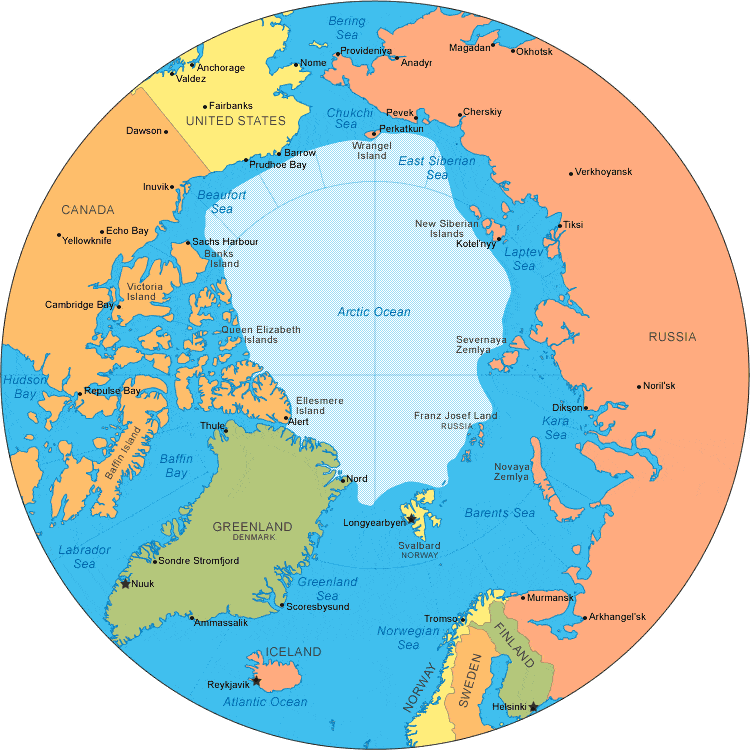
In the fifth month of 2021, the Russian military aircraft Ilyushin II-76 landed for the very first time on the Frank Josef Land archipelago in the midst of the Arctic Ocean. The plane came to rest at Nagurskoye - the Russian army’s northernmost base - carrying 80 people, as well as 3 tons of equipment required for further construction on the airbase. During the Cold War, Nagurskoye consisted only of a runway, a weather station and a communications outpost. But according to AP News, it is now “bristling with missiles and radar” and an “extended runway can handle all types of aircraft, including nuclear-capable strategic bombers”. What could the purpose of these recent developments be? Is it simply Russia’s way of flexing its political muscle, or something far more sinister? What is going on in the Arctic? Let’s find out.

First of all, how exactly do we define the Arctic? As established by most geologists, the Arctic is the area between Arctic Circle, a major latitude that is 66.5 degrees north of the Equator, and the North Pole, which is situated a whole 90 degrees above the Equator. The region consists mainly of liquid saltwater, with most of its freshwater frozen in the form of glaciers and icebergs.

A map of the Arctic and surrounding nations sourced from https://geology.com/world/arctic-ocean-map.shtml

Unlike Antarctica, which covers roughly the same area as the Arctic, the latter region is inhabited. Yes, it's true! The Arctic is in fact home to four million people, including one million indigenous people divided into over 40 different ethnic groups. The majority of this indigenous population lives within the borders of a country and therefore falls under its administration, although some groups - like the Inuit of Canada - are fighting for their right to self-government.

The Arctic is surrounded by eight countries, each owning a small slice of it: Canada, Denmark, Finland, Iceland, Norway, Sweden, USA, and, of course, Russia. The governments of these countries, together with representatives of the Arctic’s indigenous population, form the Arctic Council. Established on 19 September 1996 upon the signing of the Ottawa Declaration, this body helps maintain peace in the Arctic by promoting "cooperation, coordination and interaction" among its members. It plays a major role in sustainable development and environmental protection in the region. Most of its work is, however, research-based, as the Council refuses to "enforce its guidelines, assessments or recommendations." The chairmanship of the Arctic Council rotates every two years among the Arctic States, the current chairman being none other than the Russian Federation. But while this Council keeps peace in the Arctic, it does not own the entirety of it. So who does?

The simple answer is nobody. The eight nations surrounding the Arctic Ocean merely own strips of land on its coastline and can, according to the United Nations Convention on the Law of the Sea, exploit resources from the seabed upto 370 kilometres off their shorelines. The Arctic Ocean itself, though, being an (albeit mostly frozen) ocean, has no owner. But is this about to change?

Due to climate change, the blanket of ice covering the Arctic Ocean has begun to melt rapidly. According to Richard Powell, a polar geographer at the Scott Polar Research Institute at the University of Cambridge, the Arctic will be ice-free by “around 2040 or 2050”. As the ice melts, it leaves behind it an estimated 13% of the world's undiscovered oil and 30% of its undiscovered natural gas, which have long been buried under the frozen surface. The demand for such resources, while lessened since the introduction of renewable sources of energy, is still exceptionally high. Therefore, countries like Russia and the USA are likely to compete for dominance over this well of untapped resources. This brings us to Russia’s latest move.

Russia’s expanding its military base closest to the Arctic has aroused suspicion that the country plans to make a grab for the resource-rich region. “We have concerns about some of the recent military activities in the Arctic that increases the dangers of accidents and miscalculations and undermines the shared goal of a peaceful and sustainable future for the region,” stated USA Secretary of State Antony Blinken. As of now, the Russian Federation has only militarised its own territory. Will it dare to invoke the Arctic Coucil's wrath by venturing further? On one hand, it is clear that countries like the USA will not take any such attempt of Russia's lying down. On the other, the Arctic Council’s mandate explicitly excluding military security would enable Russia to carry out such a scheme without its intervention.

If the Russian government were to get its hands on unclaimed Arctic terrain, it would most likely result in what several ironically refer to as the "new Cold War".

Tuesday, 31 August 2021

A Tale as Old as Time

Tick tock! It is I, Sir Tickalot, and this is the thrilling tale of my life, complete with my brilliant ideas and daring exploits. So, dear reader, buckle up for an incredible journey through time!

My story began on a frosty December morning in 1991, when I was built by an eccentric old clockmaker in an apartment in Maastricht, Netherlands. It was there I spent the golden days of my childhood, ticking away in joy. Alas, my happiness was short-lived. Soon, the clockmaker hauled me to his shop, a dark, dusty flat right above his living quarters. At first, I was miserable - after all, a beauty like me didn’t belong with the common timepieces in the scrappy store. As time passed, however, the rundown little shop almost became a home to me. I even found companionship in two ornate cedar clocks, Mr and Mrs Brown.

Unfortunately, four years later, my world was upended again. One evening, a middle-aged couple entered the shop in search of a clock for their brand-new house. My comrades and I expected them to pick one of the newer models, but when they caught sight of me, their eyes seemed to widen in glee before they turned to each other, whispering excitedly. Nine minutes later, I was lying in the trunk of their car, being driven to their house in Amsterdam.

While my latest residence looked homely from the outside, I soon learned it wasn’t the safe haven I had hoped for. No, my new owners had three dreadful children, who seemed intent upon causing my early demise. The eldest daughter, Elsa, often tapped callously on my delicate glass visage, traced my intricate engravings with razor-sharp fingernails, and yanked me open to see the bottle-holder behind my door. The five-year-old twins, Dirk and Lara, dashed madly around the house every single day. I lived in constant terror of being knocked over and destroyed.

After a month of this misery, I decided enough was enough. At the stroke of midnight, when the family was nestled snugly in their beds, I climbed out the window, onto the road, and into the warm bakery just next door. I was discovered by the delighted baker, who placed me upon the mantle above the hearth. For a decade after that, I watched over the boulangerie with a flowerpot and candelabra for company.

But in the first week of 2006, disaster struck. The baker passed away, and I, along with his other possessions, was shipped away to his niece, Charlotte. Charlotte took one look at us, sighed heavily, and shut us all up in an attic full of cobwebs. I must admit, being tossed among broken playthings and unusable tools was a severely harsh blow to my ego. The year I spent in that loft was the worst of my existence.

Still, I didn’t lose hope, and a year and three months later, things began to look up for me again. Queen’s Day, or the birthday of the Queen Juliana, was approaching. Every year on April 30th, the people of Netherlands celebrated the deceased queen by dressing in orange, hosting parties, and most importantly, selling everything from decrepit furniture to fashionable outfits on every street in the country.

At the crack of dawn on the 30th, my fellow inmates and I were finally released from our prison and laid out on Kerkstraat, a narrow, cobbled street guarded by towering buildings, with an elegant church at one end. Soon, other stalls were set up around us, and hoards of shoppers arrived to poke and prod at us, deciding which of us was worth their money. I waited with bated breath to be chosen, but hours passed and no one spared me a second glance. I began to despair. What if no one picked me? What if I was tossed back into the attic, all alone this time? What if I spent centuries there, until I wasted away and ceased to exist? Just as I was about to give in to those dark thoughts, I spied a couple walking purposefully towards me. I straightened up with anticipation, praying that they would decide to purchase me. The woman, who seemed to be pregnant, enquired how much I cost. When Charlotte replied that they only had to pay five euros for me, they were ecstatic. They carried me to their canal-house that overlooked not a canal, but a football field. Please don’t ask me to explain why, as it puzzled me, too, for several days.

While I wasn’t trying to fathom what sort of house they lived in exactly, I spent my time observing the house’s occupants. They were lovely people who treated me better than anyone else ever had. They asked me the time, rewound me when I gained minutes (for while ordinary clocks slow down over time, I speed up) and brushed me down when I grew dusty. When they gave birth to a baby, I watched over her. When they moved to India, I moved too, satisfied as long as I was near them. I travelled all over the world with them, in fact, and yet it never frazzled me. For, wherever they took me, one thing stayed the same - I was finally home.

Disclaimer: This piece of writing was originally published by Timbuktoo Young Authors Publishing in its anthology, Precious, in 2021.

Math Anxiety in Indian Students: Factors and Interventions

From September to December of 2024, I had the privilege of participating in the course Education, Literacy and Justice as part of my contin...