Thursday, 3 January 2019

In the darkness


Image source: https://www.youtube.com/watch?v=TiIXLKWXmBw

Aeons ago, long before time itself existed, lived a clan of miserable beasts: the damonians. The damonians lived in a world of nothingness. All they felt was hunger, exhaustion, sorrow, regret and depression. There was nothing around them but darkness. No land, no water, no food, no other living beings… they survived by killing and eating one another – or they starved to death.

For a long time, their kind searched and searched for something more, all in vain. Most died of hunger and exhaustion, while some even took their own lives.

They gave up hope that there was something beyond this loathsome, rebarbative world. Soon, they reached the brink of extinction. Their race might have been wiped out completely if not for Wolvian.

Wolvian, a young damonian lived in constant terror as he knew that if he wasn’t alert during every waking moment, he would be killed by his own relatives in an attempt to satisfy their hunger.

After a long time span of this miserable existence, Wolvian, not unlike his great ancestors, desperately longed to change his way of living. He had willpower and ambition, and he sincerely believed that there was more to life than what his clan knew, and all he had to do was discover the right lens to see the true picture.

He searched, walking in a single direction for a long period of time, though he grew old and weary.

Finally, he found something he had never seen before. It was stunning and at first, he couldn’t move, frozen with shock, surprise and so much more. What he was looking at was huge. So huge, in fact, that he couldn’t see its end. It seemed to go on forever and ever. He used the last of his energy to run towards it.

It was in a colour similar to his fur, but lighter and more beautiful. Slowly, cautiously, he dipped a paw in it. It felt wonderful…. It was cool, and it left little circles of itself on his paw. The circles disappeared quickly but he could still feel them in his fur.

He put his paws into this strange miracle again, and it splashed up against him. At that moment, he felt something he didn’t understand. It made him want to screech, jump, and run around wildly. It was tingling sensation, so lovely he didn’t know how to describe it. It was a feeling that none of his kind had ever experienced before.

Joy.

Sunday, 25 November 2018

My View on the Sabarimala Controversy


Image source: http://mattersindia.com/2018/10/sabarimala-all-one-needs-to-know/


Sabarimala is a temple for the worship of Lord Ayyappa. It has been visited by pilgrims for more than nine decades and is now one of the most controversial topics in the news.

 For a very long time [maybe even since the temple was built], women between the ages of 10 to 50 did not enter the temple. This is what most people think. However, it is partially incorrect. There was an informal ban on women entering the temple but it wasn’t always strictly followed. There are records of the Queen of Travancore entering the temple in 1939 when she was around that age, and many more such records of women of this age entering during important festivals. This proves that the ‘ancient traditions that must be upheld’ aren’t that ancient after all. It was only around the 1970s that women were really banned and now people are using this tradition as yet another excuse to put down women.

The next point I must make is related to the argument most people I speak to about this use: It’s a tradition, and breaking it is offensive to Hinduism. Just because something is a tradition, it doesn’t necessarily have to persist. Not every tradition is right. For example, untouchability. This was a huge part of Hinduism, but now it has been forbidden, according to the Right to Equality in our Constitution. There is one story about an ‘untouchable’, which I think is very relevant to our topic.

Image source: https://en.wikipedia.org/wiki/Kanaka_Dasa


When the Udipi Krishna temple was first built, Saint Madhvacharya had originally installed the Govinda idol facing east, as was the custom. Kanakadasa, an ardent devotee of Lord Krishna, visited the temple. However, as he was from a low caste, he wasn’t allowed to enter from the main eastern entrance. Kanakadasa ran to the western side of the temple and pressed his eyes against the holes in the wall, begging Krishna to appear before him. The idol of Krishna, impressed by his loyalty and dedication, slowly turned to face him. Thus, Kanakadasa was able to see Udipi Krishna.
The reason I have written this story out for you is that I feel that history is repeating itself. A few decades ago, we didn’t allow Dalits into our temples. Now, aren’t we discriminating against women in the same way?

While women around the world are fighting for equality, I find it surprising that we women ourselves are protesting against our own right to enter temples. Take the time when Trupti Desai tried to enter Sabarimala for example. Hundreds of people blocked her at the airport – and who were most of these people? Women.

However accomplished we imagine ourselves to be, we are still close-minded and backward in our thinking if we deny simple rights like these to equal human beings.

I do not mean to offend in any way by writing this blog. I’m only expressing my opinions on the subject and hoping that perhaps a few readers will rethink their stance and maybe even agree with me. Thank you.

Sunday, 28 October 2018

The Legend of Egypt’s Sacred Family


Hi everyone and welcome back to my blog.

I recently visited Egypt, so I have written the story of the Sacred Family. The Sacred Family consisted of three deities – Osiris, Isis and Horus, father, mother and son respectively. They were worshipped by the ancient Egyptians in numerous temples and monuments. Here, I have written their story from Isis’ point of view.

Image source: https://www.mygodpictures.com/osirisisis-and-horus/

How did Isis feel when her husband was murdered, when Horus trained for the most vital battle of his life and when the time finally came for him to fight?

Read on to find out.

Isis’ Records

A terrible loss has befallen me today. Because of this, the whole kingdom shall suffer. My brother-in-law, Set assassinated my husband! How dare that traitor just barge into our beautiful palace, kill my husband Osiris, and sit on the royal throne?

I immediately rushed to draw my sword, but a woman is not permitted to fight a battle, especially against a man, in the kingdom of Egypt.

Osiris has been blasted into millions of pieces by that renegade Set and I have been banished from my position as Queen of Egypt. I must seek guidance from Amun-Ra, God of the Sun, on how to resurrect Osiris.

I can only hope that he’ll help me save my husband, and consequently, all of Egypt. 

____________________________________

I finally met Amun-Ra and he gave me much hope. The possibility of saving Osiris, of bringing him back to life, seems very high.

As I have recorded previously, Osiris has been broken into millions of pieces and Amun-Ra has given me wings to search for them and put Osiris’ body back together.  I shall start today, and hopefully my work will be completed by the next feast of Opet.

Image source: https://isiopolis.com/2013/12/01/why-does-isis-have-wings/
____________________________________

Today is a day of joy and faith for the subjects of Egypt. After almost a year of searching, I, Queen Isis have found all the pieces of Osiris. Tomorrow, as all of Egypt watches, he shall be brought back to life. Nephthys, my beloved sister, who aided me while I was searching, shall accompany me to this delightful ceremony. I’m pleased that Osiris will finally be saved.

However, his resurrection will not be complete until his death is avenged. We must have a son who will take revenge on Set and restore harmony in Egypt. I have decided what I shall name him.
Horus, the falcon-headed god of protection shall be born this year to save us.

____________________________________

It has been a long time since I last wrote. Osiris’ and my son shall be born in a month’s time. Only 30 days left! Once Horus is ready, I will see to it that he is trained well enough to take on Set and defeat him. But for now, I must wait.

____________________________________

Horus is only a young and vulnerable boy now, not ready for training. However, I see a spark in him. He is brave and diligent and seeks a chance to avenge his father. In some time, he shall become one of the greatest heroes in history.

Image source: http://www.egyptianmyths.net/mythisis.htm

____________________________________

Horus’ training has begun. Maat, goddess of order, is teaching him the rules of warfare, while our best warriors train him in archery. I am personally training him in the art of the spear fighting and it won’t be long before he is ready. That despicable Set better watch out!
____________________________________

Horus has married Hathor, goddess of love, joy and music. She is sure to bring Horus luck when he confronts Set. She has already given us some vital news: Set knows that Horus is seeking revenge, and that coward has taken the form of a hippopotamus and is in hiding underwater to escape Horus’ wrath.

Image source: http://canacopegdl.com/keyword/horus-hathor.html

The time has come for Horus to fight what will be the greatest battle ever witnessed – a battle against Set to fully resurrect and avenge his father.

____________________________________

We are sailing down the Nile, searching for any sign of Set. So far, this has proved unsuccessful but we must persevere. Hathor and I are here with Horus, to help him. Hathor is polishing his spear and sharpening its blade while she watches the water below for any sign of movement.

Wait! Horus has spotted something!

In the distance, there’s a grey dot just below the surface. We are rowing as quickly as possible towards it but…. Amun-Ra please help us!

We are here, and yes, that is Set! Horus has grabbed his spear and is lunging at that monster… that was a deft blow and it hit Set’s leg.

Image source: https://www.sacred-texts.com/egy/leg/leg07.htm


Oh! I should have known that Set would not be defeated so easily. He’s beginning to fight back…. Horus is holding his own….aah! No! Horus has been hit in the eye – this can’t be happening! Horus is failing, letting Set gain the upper hand.

I have to help him but Hathor isn’t letting me go. I must do something!

Wait…it’s alright! Horus is fighting back, valiantly swinging his spear as Set trembles at his might. He has utilised a trick I taught him years ago and now he has managed to disarm Set. Set is trying to flee, but he’s cornered. Horus has struck Set’s leg, and Set is screaming in pain.

One more strike and he’ll be unable to move. Yes! Horus has done it!

Horus has a cut in his arm and an eye has been taken out by Set. But these are mere trifles. My son, Horus, god of protection, the falcon-headed one, has destroyed Set, completed Osiris’ resurrection and rescued Egypt from a tyrant’s rule!

Horus will return victorious from this struggle and the people of Egypt shall bask in his reflected glory.

All shall kneel before Horus, King of Egypt!


Wednesday, 3 October 2018

The Story of Karna – A Story of True Friendship


Image courtesy: http://www.indiaheritagedesk.com/event/music-dance-rashmirathi-a-story-of-karna/


Karna, a key character in the Mahabharata (a well-known Indian epic), is a tragic hero with a unique story. He faced many difficult decisions, and people have differing opinions on whether what he did was right or wrong. Here is a short summary of his story, and what I think about it.

Karna was a charioteer’s son and his family was very poor. Despite this, Karna was very skilled in archery. One day, an archery contest was held by the royal family of Hastinapur in celebration of the Pandavas and Kauravas (princes and heirs to the throne) completing their training under their teacher, Guru Drona. Karna knew he had a chance of winning and entered the contest, in which Arjuna impressed the onlookers by shooting blindfolded, and creating fire and rain with arrows. Drona remarked that none of the participants could match Arjuna in archery. Then, Karna stood up and did everything that Arjuna had just done, equally well. Drona, astonished that somebody was as proficient in archery as Arjuna, asked Karna to compete against Arjuna and prove how dextrous he really was. That was when Karna’s father, pleased that his son could match the gifted Arjuna, rushed out of the crowd to congratulate Karna and hug him.

There was an uproar when people realised that Karna was a charioteer’s son, and he was immediately disqualified because of his caste. It was then that Duryodhana stepped forward and announced that this was unfair. Duryodhana was the oldest Kaurava and hated the Pandavas as the oldest Pandava, Yudhishtra was the heir to the Hastinapur throne. He always tried to bring about their downfall with his cunning plans. However, he thought that Karna being discriminated against was unfair as Karna was as capable as Arjuna was. So, feeling bad for Karna, Duryodhana made him the King of Anga so he too could compete in this contest for royalty. Karna felt grateful to Duryodhana and soon became his closest friend.

Many years later, the Kauravas, who wanted Hastinapur for themselves, waged war against the Pandavas, the rightful heirs to the throne. This was also when Karna realised that he was the oldest Pandava brother. He had, in effect, been abandoned at birth and adopted by a charioteer. So, why did he fight on Duryodhana’s side, against his own brothers who were on the side of righteousness?

There are many opinions on this. Karna had to choose between two important things – being righteous (Dharma) and being a true friend. Personally, I think Karna did the right thing. Duryodhana was a true friend – he helped Karna during his time of trouble – and I feel that Karna was right to repay his kindness in this manner even if it meant fighting for the wrong cause.

Let’s continue with the story.

The war went on for many days. Karna decided to confront Arjuna, whose charioteer was none other than Lord Krishna himself. When Karna’s chariot got stuck in the mud, his charioteer Shalya refused to alight from the chariot and lift the wheel out. So, Karna had to step down and try to free the wheel. At that moment, when Karna was completely defenceless, Krishna ordered Arjuna to shoot and kill Karna. That is how Karna died.

Why was he killed in such an unfair way when it was a rule in warfare to never assault an unarmed warrior? Here is Krishna’s explanation of this incident – so many times, when Duryodhana was unjust (like when his army assaulted an unarmed and lone Abhimanyu), did Karna try to stop him? No. Karna always supported Duryodhana, even when he knew that Duryodhana was wrong and unjust. And hence, Karna deserved everything that happened to him.

But I say – wasn’t Karna just doing his duty as a friend – fulfilling his Dharma as a friend? Karna was a true friend – come what may, he was always loyal to Duryodhana. Maybe he gave his loyalty wrongly, but he knew that he owed Duryodhana for his kindness and so he fought on Duryodhana’s side throughout.

And wasn’t what Krishna did also unfair? Was what happened to Karna really fair? Was it righteous

Whatever the answer to these questions, Karna is now considered a great tragic hero and his is one of the greatest stories of friendship. When he was given a choice between being a true friend and following the path of righteousness, he chose being a true friend. What would you choose?


Sunday, 16 September 2018

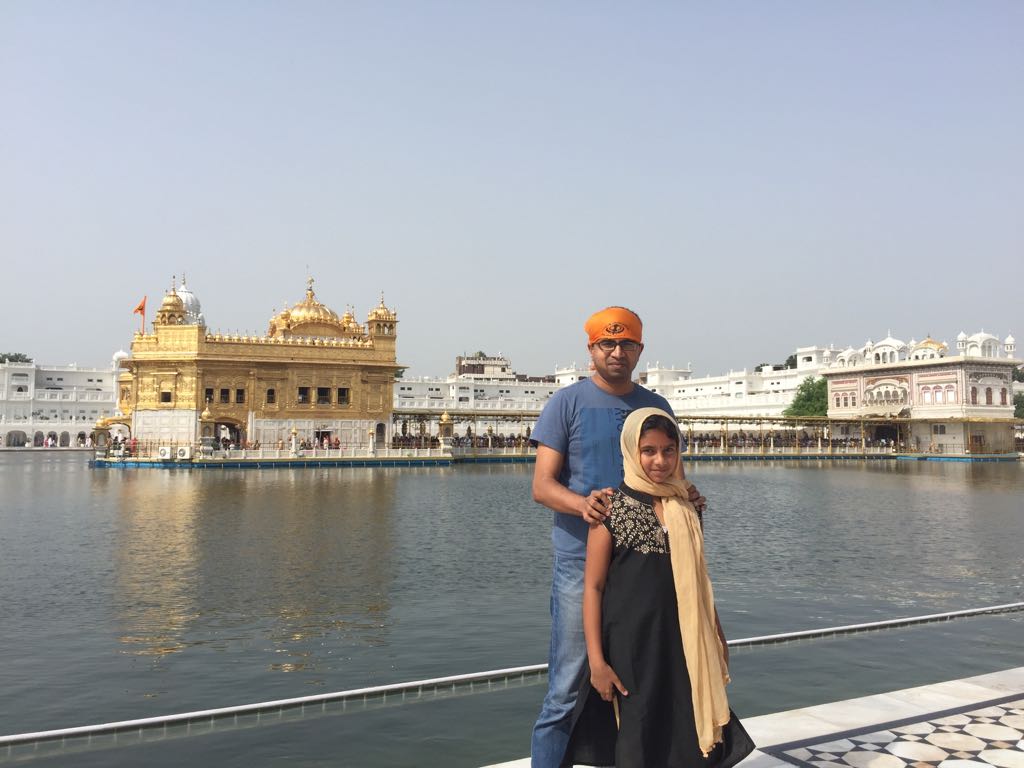
What I learnt about Sikhism in Amritsar


Sat Sri Akal!

Guess where I just got back from….? Amritsar! Amritsar is a city in Punjab and a popular tourist spot, famous for Harmandir Sahib, or the Golden Temple.


57.69% of the people in Punjab are Sikhs, so I decided to find out more about them. Here are some interesting facts about Sikhs and their distinctive religion.

Sikhism, a monotheistic religion, emerged in the 15th century in Punjab, India. It was a militaristic religion that was established to fight against the Mughal invaders. Sikhs follow the scripture Guru Granth Sahib and believe in only one God. They follow gurus too.

One thing that is truly impressive about the religion is the concept of ‘seva’ or service to people. At the Golden Temple, there were many people, old and young, rich and poor, doing different jobs like storing others’ shoes, giving out cups of water, making and serving food.

When we asked various people about how we could do service too, they said we could just walk in, wash our hands and do whatever form of service we liked for however long we wanted, from five minutes to four hours!


Sikhism has five symbols – kesh (uncut hair), kara (steel bangle), kanga (wooden comb), kirpan (sword), and kacchera (long underwear). I think Sikhs are very religious people as most of the Sikhs I saw at the temple carried kirpans, had long hair and wore karas.

I was fascinated to see the kirpans that so many people were carrying around with them, and the shops that sold so many different types – sharp and blunt, simple and fancy, short and long.

Sikhs were deeply affected during the partition of India, though they were neither Hindu or Muslim. When we visited the Partition Museum we saw how horrible the partition was and how so many innocent Sikhs were massacred. Almost no Sikhs in West Punjab survived, as they were brutally killed. Trains carrying Sikhs from Pakistan arrived in India full of blood and corpses as the trains had been attacked by mobs on the way.

But some Sikhs, Hindus and Muslims actually helped each other. Sarjit Singh Chowdhary, a Sikh soldier, helped Muslims cross the border and might have saved the lives of a few hundred people!

Overall, I think Sikhism is a very interesting religion that adds to India’s diverse culture.

Saturday, 7 July 2018

The History of Dragon Folklore


Dragons are some of the most popular magical creatures in folklore, but who really created the idea of these scary winged beasts? Keep reading to find out more about the history of dragons in folklore.

Where it began
Many people believe that myths about dragons originated independent of each other in China and Europe, maybe in the Americas, and Australia too. But how did these myths come about?

That looks like a dragon
So maybe these myths about dragons began when people saw creatures that looked like the dragons we see in books today. In other words, animals that seemed truly terrifying. Here are some animals that may have been the inspiration for dragons.

  • Dinosaurs: When humans first discovered dinosaur fossils, they probably misinterpreted them as dragon fossils. Take the fossilised stegosaurus, for instance. It is an average of 30 feet in length and approximately 14 feet tall, covered in armoured plates and spikes to defend itself. Doesn’t that seem like a dragon?
  • Whales: Ok, ok, whales are marine animals, right? And people probably didn’t think they looked like dragons – that’s crazy! Wrong! Early humans probably discovered whale bones, and had no idea that whales were marine. And such humongous bones looked like they belonged to a ferocious beast.
  •  The goannas: Australia is home to numerous species of monitor lizards, also known as goannas. Goannas have razor shar teeth and claws, and produce venom that causes their victims’ wounds to develop infections after an attack. Sound like a dragon?
  • Snakes: How many people are scared of snakes? Almost everyone. But have you ever thought of how similar snakes are to dragons? Firstly, both are reptiles. Secondly, both are scary and can kill you. Could snakes be the inspiration behind dragons?
  • Humans: The most amazing explanation involves us, humans. Throughout evolution, a fear of unknown animals and beasts has been implanted in our minds. So maybe since humans fear death most, the human brain itself invented a scary beast that could kill us with one blow.


What I personally think is that dragons are metaphors, symbolic of evil. In many stories, we read about dragons kidnapping princesses and brave knights defeating the dragons to save the beautiful princesses. I feel that maybe man wrote these tales to give people hope: to show us that good always defeats evil.
What do you think is the reason behind the creation of dragons? Maybe one of the above reasons? Or something else? Whatever it is, the myth of dragons has had a huge impact on stories around the world, from King Arthur’s Knights of the Round Table to Harry Potter!

Monday, 21 May 2018

Hetty Feather: A Book Review


Hetty Feather, by Jacqueline Wilson, is a fun, thrilling and heartfelt book, loved by children and teens everywhere. I enjoyed this book so much that I decided to review it. So here it is!

Hetty is a fiery but kind young girl. She lives with her foster family, and her dear foster brother Jem, whom she admires and loves more than anyone else. But Hetty has one problem – the foundling hospital.

When Hetty was a baby, her mother couldn’t take care of her and had to send her to the foundling hospital. She was then taken in by her foster family, who Hetty has lived with for more than four years now.

The moment she turns five, Hetty will have to go back to the foundling hospital. She will have to leave her foster parents and siblings and her wonderful Jem, to go live in a terrible hospital with cruel matrons, nasty girls and millions of rules that stop her from having any fun at all.

Can Hetty manage to survive at the horrible hospital? Will she even see her dear Jem again? And maybe, just maybe, could she find her real mother?

I loved this book and I just couldn’t put it down. I was completely engrossed in reading about Hetty’s intriguing experiences, from sneaking into a circus, to being locked up in a dark room overnight at the foundling hospital, to searching for her biological mother.

I love Hetty because she is so confident and funny, unlike so many boring, saintly characters in other books. I’m sure any girl between the ages of 10-14 can relate to her thoughts and feelings.

Hetty Feather is my favourite storybook character and I can’t wait to read (and review) the sequels to this book.

Math Anxiety in Indian Students: Factors and Interventions

From September to December of 2024, I had the privilege of participating in the course Education, Literacy and Justice as part of my contin...