Saturday, 23 October 2021

Squid Game: What Makes it Special?

Since its release on 17th September, Squid Game has quickly become Netflix’s most watched series of all time. The show revolves around 456 people, each deeply in debt, who enter a tournament that promises them an escape from their financial struggle in the form of a cash prize of billions of won (Korean currency). What they don’t realise until the first round, however, is that the contest’s losers must pay a deadly price.

The concept of the show is fairly simple - every episode, the characters play a game. The few who win this game progress to the next round, until by the end, only a handful remain to claim the final prize. So why exactly is their story so appealing to such a broad range of audiences? How is it that in less than a month, Squid Game has gained 111 million viewers, beating fan favourites like Bridgerton, The Witcher, and Stranger Things to the top spot?

Disclaimer: This article contains spoilers for the first two episodes of Squid Game.

First of all, there’s the rather obvious aspect of the show’s spot-on commentary on capitalism. Like in The Hunger Games, the impoverished, underprivileged, and mistreated are forced to fight to their deaths, each of them merely a pawn in a game that the ultra-rich watch for entertainment. What sets Squid Game apart, though, is this simple fact: every one of the participants in these games makes a conscious choice to play them.

In signing consent forms, in voting, in staying in the competition even when offered a chance to leave, the contestants repeatedly choose to place themselves in immediate danger of grisly, gruesome deaths. The idea that hundreds of people would go through such torture just for a fleeting chance (ironically, a chance offered to them by the very perpetuators of the system that oppresses them) at a life of freedom from starvation, from debt, from all the evils of the capitalist economy, punches the viewer in the gut, awakening them to the incredible agony caused by the laissez-faire system. As reasoned by Arirang Meari, "Squid Game gained popularity because it exposes the reality of South Korean capitalist culture." While a North Korean state-run site may not be the most credible source around, this is still a point worth reflecting on!

Another unique and unexpected concept the series explores is that of equality. The characters in Squid Game have all faced extreme forms of inequality before entering the tournament. There’s Ali, who faces racial inequality. He migrates from Pakistan to South Korea hoping to secure a stable job, is exploited ruthlessly by his employer, and finds himself unable to feed his family. Then there’s Sang-Woo, who faces socio-economic inequality. After growing up in poverty, he briefly benefits off the capitalist regime, only to find himself drowning beneath its treacherous tides all over again.

The game’s organiser realises this, and even explains, “everyone is equal while they play this game. Here, the players get to play a fair game under the same conditions. Those people suffered from inequality and discrimination out in the world, and we’re giving them the last chance to fight fair and win.”

On the surface, this policy seems to ensure that all the players are equal in every sense. What it fails to take into account, though, is the fact that some players are already at a disadvantage due to overlooked factors. Both Sae-Byok and Ji-Yeong, being women and therefore physically weaker than the others, are excluded from multiple alliances and obliged to find their own means of survival. Similarly, Player 001 has the lower hand throughout the tournament simply due to his age, which slows down his mind and body. For these contestants to be equal to the others, they must first be granted additional benefits to compensate for those they naturally lack.

Here, Squid Game accurately and realistically demonstrates the difference between equality and equity, while keeping the theme subtle enough not to dominate the plot of a single episode.

The series also touches on universal human qualities, which are relatable to viewers across the globe. Dan Brown once wrote that “when they face desperation… human beings become animals.” This is true of the world’s entire population, including you and me, and Squid Game proves it time and time again.

While several pieces of media romanticise human desperation, this serial’s portrayal of the emotion is dark, dolorous and real. Contestants who start out as optimistic, idealistic, and generally good at heart become self-serving, immoral and inhumane. People who usually wouldn’t hurt a fly commit atrocities in the blink of an eye just for a minute increase in their chances of survival. By the end of the show, the characters have descended so far into depravity that they are barely recognisable as their original selves. Squid Game forces viewers to confront the darkest parts of themselves when they realise that they would make the same perverted choices as the players were they thrown into the same perverted circumstances.

Finally, despite all this, Squid Game’s perspective on humanity is not entirely cynical. At the very end of the series (minor spoilers ahead), Gi-Hun makes a final bet, this one on the inherent goodness of people. Just as the audience begins to lose faith in Gi-Hun’s belief that there is still some virtue in humankind, a single good deed proves him right after all. However bluntly, almost aggressively, the programme showcases humankind’s flaws, it leaves us with a message of assurance. That however dire circumstances may seem, there is always a chance that things will get better. The idea of hope, represented in various charcaters’ small yet significant acts of kindness throughout the series, is summarised succintly in this one scene.

Squid Game fascinates every one of us because it represents our everyday struggle for survival, albeit in an exaggerated, dramatised manner. It is a must-watch for everyone, from a casual Netflix enthusiast to a serious Marxist reformer.

Saturday, 16 October 2021

Prompt Writing: "The virus was born in Wuhan"

Disclaimer: The events of this story are entirely fictional. Any resemblance to real people, places or happenings is due to the author’s complete lack of originality.

The virus was born in Wuhan. There are theories about what caused it - a freak of nature, perhaps, or a virology experiment gone wrong - but no concrete proof has been found either way. Besides, we have far more pressing problems to deal with first. As I was saying, the virus was born in Wuhan, but it didn’t stay there forever. It spread, and it spread, and it spread, until it had reached every corner of China, from the beetle-frying, puppy-boiling kitchen of a popular restaurant in Beijing, to a store in Shanghai that sold fans and parasols made in Japan as exotic Chinese paraphernalia to unsuspecting tourists. Still, China’s government turned a blind eye to it, unhelpful and unsympathetic.

By the end of the year, the contagion had reached Spain, USA, India, more countries than I can venture to name. It was given the name COVID - CO for Corona, the virus’ family, VI for virus, and D for disease. Ignoring it was no longer an option. Instead, terms like “contact tracing” and “vaccine testing” began to jump out from every newspaper’s headline, the once-low demand for masks and sanitiser bottles shot through the roof, and a man in Uttar Pradesh made a fortune selling magical cow urine that, once swallowed, would supposedly grant its drinker immunity from the virus.

Despite thousands of statements to the contrary from brainy boffins across the globe, people persisted in believing that the threat was temporary, and would be gone in mere months’ time. They continued to live their lives as they pleased, sanitising their hands every now and then and wearing their masks below their chins and demanding of anyone who questioned them, “what’s the point in staying home when this virus will be gone in a couple of weeks anyway? Just chill out.”

Alas, those boffins were right. Before long, hospitals everywhere were filled to the brim with the infected, while the few and fortunate healthy stayed locked up at home, now too afraid to step out even to buy groceries. In Italy, deaths surpassed availability of graves by so much that rotting corpses lined the streets of every city. In the USA, President Trump announced 99% of COVID cases were “totally harmless” as people coughed to death three blocks away. And in North Korea, any civilian found infected with the virus, be they adult or child, was allegedly shot dead on the spot to prevent further diffusion. The entire world was in pandemonium.

When we had just about given up hope on our lives ever returning to normal, though, we discovered a ray of light at the end of the tunnel. A vaccine was released. 13 different vaccines, in fact, from the AstraZeneca’s sought-after Covishield to the Russian Federation’s Sputnik V, which might as well have been cow urine for the public’s lack of faith in it.

The rich were vaccinated first, of course. They carried out their own form of contact tracing, locating doctors and hospital owners and vaccine suppliers to beg of and borrow from and bribe. The middle class, too, were soon vaccinated by corporate, neighbourhood and government sponsored drives. Last came the poor, who gratefully accepted whichever cure was available to them, be it a sealed vial of Covishield or a random plastic box containing an unknown florescent liquid. Soon, there weren’t many who remained unvaccinated. There was the Texan Patrick Patriot, who refused to be injected with a serum that would supposedly make him autistic. There was the Tamilian Shailaja Swami, who had heard from her neighbour that the vaccines were made in China, “just like every other piece of kuppai in this world,” and would probably be the death of them all. There was the British Con Spirator, who declared to anybody who wanted to listen - and even those who didn’t - that Bill Gates had planted a chip in every dose of the vaccine, and could now monitor the activity of vaccinated individuals.

Despite this handful of fools, the majority of the global population was fully vaccinated by the beginning of 2023. We celebrated, believing we were safe, imagining we were finally, finally free of the menace that had plagued our lives since 2020. We had no means of knowing, then, of the decades of agony to come. Of the hundreds of mutations, the thousands of onslaughts, the millions of deaths. We had no means of knowing that this was only the beginning.

Friday, 8 October 2021

The Race for the Arctic

An image of the Nagurskoye airbase sourced from https://en.wikipedia.org/wiki/Nagurskoye_(air_base)

In the fifth month of 2021, the Russian military aircraft Ilyushin II-76 landed for the very first time on the Frank Josef Land archipelago in the midst of the Arctic Ocean. The plane came to rest at Nagurskoye - the Russian army’s northernmost base - carrying 80 people, as well as 3 tons of equipment required for further construction on the airbase. During the Cold War, Nagurskoye consisted only of a runway, a weather station and a communications outpost. But according to AP News, it is now “bristling with missiles and radar” and an “extended runway can handle all types of aircraft, including nuclear-capable strategic bombers”. What could the purpose of these recent developments be? Is it simply Russia’s way of flexing its political muscle, or something far more sinister? What is going on in the Arctic? Let’s find out.

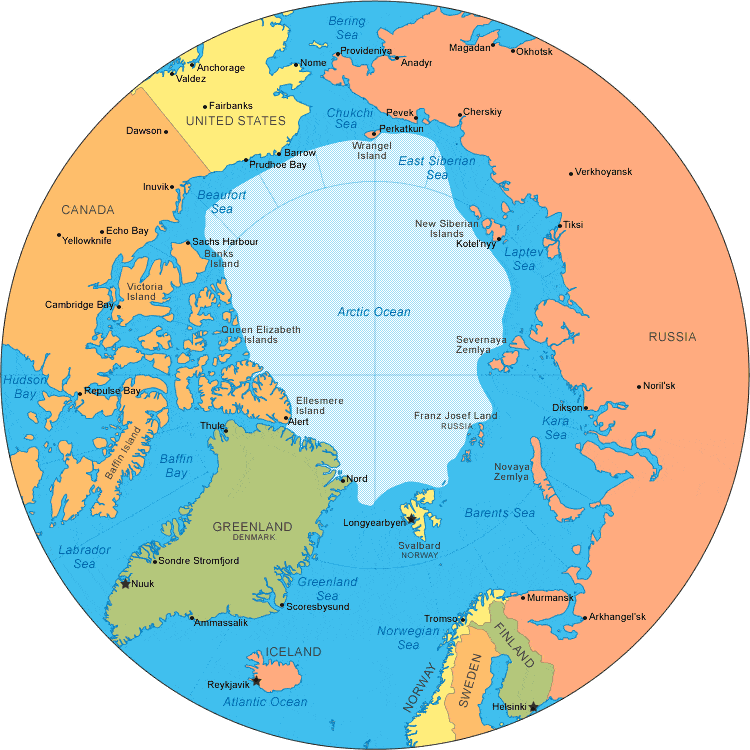
First of all, how exactly do we define the Arctic? As established by most geologists, the Arctic is the area between Arctic Circle, a major latitude that is 66.5 degrees north of the Equator, and the North Pole, which is situated a whole 90 degrees above the Equator. The region consists mainly of liquid saltwater, with most of its freshwater frozen in the form of glaciers and icebergs.

A map of the Arctic and surrounding nations sourced from https://geology.com/world/arctic-ocean-map.shtml

Unlike Antarctica, which covers roughly the same area as the Arctic, the latter region is inhabited. Yes, it's true! The Arctic is in fact home to four million people, including one million indigenous people divided into over 40 different ethnic groups. The majority of this indigenous population lives within the borders of a country and therefore falls under its administration, although some groups - like the Inuit of Canada - are fighting for their right to self-government.

The Arctic is surrounded by eight countries, each owning a small slice of it: Canada, Denmark, Finland, Iceland, Norway, Sweden, USA, and, of course, Russia. The governments of these countries, together with representatives of the Arctic’s indigenous population, form the Arctic Council. Established on 19 September 1996 upon the signing of the Ottawa Declaration, this body helps maintain peace in the Arctic by promoting "cooperation, coordination and interaction" among its members. It plays a major role in sustainable development and environmental protection in the region. Most of its work is, however, research-based, as the Council refuses to "enforce its guidelines, assessments or recommendations." The chairmanship of the Arctic Council rotates every two years among the Arctic States, the current chairman being none other than the Russian Federation. But while this Council keeps peace in the Arctic, it does not own the entirety of it. So who does?

The simple answer is nobody. The eight nations surrounding the Arctic Ocean merely own strips of land on its coastline and can, according to the United Nations Convention on the Law of the Sea, exploit resources from the seabed upto 370 kilometres off their shorelines. The Arctic Ocean itself, though, being an (albeit mostly frozen) ocean, has no owner. But is this about to change?

Due to climate change, the blanket of ice covering the Arctic Ocean has begun to melt rapidly. According to Richard Powell, a polar geographer at the Scott Polar Research Institute at the University of Cambridge, the Arctic will be ice-free by “around 2040 or 2050”. As the ice melts, it leaves behind it an estimated 13% of the world's undiscovered oil and 30% of its undiscovered natural gas, which have long been buried under the frozen surface. The demand for such resources, while lessened since the introduction of renewable sources of energy, is still exceptionally high. Therefore, countries like Russia and the USA are likely to compete for dominance over this well of untapped resources. This brings us to Russia’s latest move.

Russia’s expanding its military base closest to the Arctic has aroused suspicion that the country plans to make a grab for the resource-rich region. “We have concerns about some of the recent military activities in the Arctic that increases the dangers of accidents and miscalculations and undermines the shared goal of a peaceful and sustainable future for the region,” stated USA Secretary of State Antony Blinken. As of now, the Russian Federation has only militarised its own territory. Will it dare to invoke the Arctic Coucil's wrath by venturing further? On one hand, it is clear that countries like the USA will not take any such attempt of Russia's lying down. On the other, the Arctic Council’s mandate explicitly excluding military security would enable Russia to carry out such a scheme without its intervention.

If the Russian government were to get its hands on unclaimed Arctic terrain, it would most likely result in what several ironically refer to as the "new Cold War".

Tuesday, 31 August 2021

A Tale as Old as Time

Tick tock! It is I, Sir Tickalot, and this is the thrilling tale of my life, complete with my brilliant ideas and daring exploits. So, dear reader, buckle up for an incredible journey through time!

My story began on a frosty December morning in 1991, when I was built by an eccentric old clockmaker in an apartment in Maastricht, Netherlands. It was there I spent the golden days of my childhood, ticking away in joy. Alas, my happiness was short-lived. Soon, the clockmaker hauled me to his shop, a dark, dusty flat right above his living quarters. At first, I was miserable - after all, a beauty like me didn’t belong with the common timepieces in the scrappy store. As time passed, however, the rundown little shop almost became a home to me. I even found companionship in two ornate cedar clocks, Mr and Mrs Brown.

Unfortunately, four years later, my world was upended again. One evening, a middle-aged couple entered the shop in search of a clock for their brand-new house. My comrades and I expected them to pick one of the newer models, but when they caught sight of me, their eyes seemed to widen in glee before they turned to each other, whispering excitedly. Nine minutes later, I was lying in the trunk of their car, being driven to their house in Amsterdam.

While my latest residence looked homely from the outside, I soon learned it wasn’t the safe haven I had hoped for. No, my new owners had three dreadful children, who seemed intent upon causing my early demise. The eldest daughter, Elsa, often tapped callously on my delicate glass visage, traced my intricate engravings with razor-sharp fingernails, and yanked me open to see the bottle-holder behind my door. The five-year-old twins, Dirk and Lara, dashed madly around the house every single day. I lived in constant terror of being knocked over and destroyed.

After a month of this misery, I decided enough was enough. At the stroke of midnight, when the family was nestled snugly in their beds, I climbed out the window, onto the road, and into the warm bakery just next door. I was discovered by the delighted baker, who placed me upon the mantle above the hearth. For a decade after that, I watched over the boulangerie with a flowerpot and candelabra for company.

But in the first week of 2006, disaster struck. The baker passed away, and I, along with his other possessions, was shipped away to his niece, Charlotte. Charlotte took one look at us, sighed heavily, and shut us all up in an attic full of cobwebs. I must admit, being tossed among broken playthings and unusable tools was a severely harsh blow to my ego. The year I spent in that loft was the worst of my existence.

Still, I didn’t lose hope, and a year and three months later, things began to look up for me again. Queen’s Day, or the birthday of the Queen Juliana, was approaching. Every year on April 30th, the people of Netherlands celebrated the deceased queen by dressing in orange, hosting parties, and most importantly, selling everything from decrepit furniture to fashionable outfits on every street in the country.

At the crack of dawn on the 30th, my fellow inmates and I were finally released from our prison and laid out on Kerkstraat, a narrow, cobbled street guarded by towering buildings, with an elegant church at one end. Soon, other stalls were set up around us, and hoards of shoppers arrived to poke and prod at us, deciding which of us was worth their money. I waited with bated breath to be chosen, but hours passed and no one spared me a second glance. I began to despair. What if no one picked me? What if I was tossed back into the attic, all alone this time? What if I spent centuries there, until I wasted away and ceased to exist? Just as I was about to give in to those dark thoughts, I spied a couple walking purposefully towards me. I straightened up with anticipation, praying that they would decide to purchase me. The woman, who seemed to be pregnant, enquired how much I cost. When Charlotte replied that they only had to pay five euros for me, they were ecstatic. They carried me to their canal-house that overlooked not a canal, but a football field. Please don’t ask me to explain why, as it puzzled me, too, for several days.

While I wasn’t trying to fathom what sort of house they lived in exactly, I spent my time observing the house’s occupants. They were lovely people who treated me better than anyone else ever had. They asked me the time, rewound me when I gained minutes (for while ordinary clocks slow down over time, I speed up) and brushed me down when I grew dusty. When they gave birth to a baby, I watched over her. When they moved to India, I moved too, satisfied as long as I was near them. I travelled all over the world with them, in fact, and yet it never frazzled me. For, wherever they took me, one thing stayed the same - I was finally home.

Disclaimer: This piece of writing was originally published by Timbuktoo Young Authors Publishing in its anthology, Precious, in 2021.

Saturday, 5 June 2021

Dreams, Screams, and Other Terrifying Themes


I hurtle through the woods, wind billowing through my fur and twigs snapping beneath my paws. I have less than a minute to catch the squirrel. If I’m even a second too slow... well, it’s best not to consider that possibility. Horror spikes through my chest as I feel my body begin to transform. It’s now or never. Bending my knees and tensing my stomach, I pounce.


And then I wake up.

**************************************************************************

“Looks like someone got up on the wrong side of the bed,” my brother sneers as I sleepily shove a spoonful of cereal into my mouth. I ignore him, too exhausted to come up with a sufficiently scathing response.

I had another of those nightmares last night, the ones that leave me drained, both physically and mentally. While I can only recall vague flashes of this one - an owl’s hoot, a strange, metallic taste, and a feeling of utter desperation - I feel as though I’ve dreamt it before, and more than once. Is that even possible? To have the exact same dream repeatedly? But I’m too drowsy to ponder it further, so I wolf down my breakfast and pad up the staircase to my bedroom. Ten minutes later, I’m sleeping like a log.

**************************************************************************

“Nila!” Mum calls from the drawing room. “Come here!”

I trudge downstairs, irritated. “What is it now?”

“Where’ve you been all day?”

“Sleeping.”

She raises an eyebrow.

“I was exhausted,” I explain defensively. “Now may I leave?”

“No, you may not. Mr. Aditya claims to have spotted a wild animal in our half of the woods last night. He’s probably just paranoid, but it’s best we’re on our guard anyway. So stay away from the forest during the day, and don’t go outdoors at all in the night. Oh, and make sure to lock and bolt the front door every evening. Is that understood?”

“Yes. Now may I leave?”

Mum merely sighs in response.

**************************************************************************

It’s been two weeks since my last nightmare, but I don’t think they’re really gone yet. I don’t remember when I had the first one, but I do know that it was here, at our farmhouse. Perhaps I’ll have to leave before I’m entirely free of them.

My mother’s shout of “Nila! Have you bolted the door?” startles me out of my reverie. There’s no point in wasting the day worrying about the night, I suppose, so I suppress my terrifying theories and do what she asks. Then I head upstairs and settle in for what I hope will be a peaceful night’s sleep.

**************************************************************************

I’m trapped. I’m surrounded by walls on all four sides, and there’s no way out. If I can’t somehow make my own way soon, I’m doomed. I have to taste blood by the break of dawn, or I’ll lose my life. I pace back and forth, claw at the ground, and growl in frustration.

I’ll do whatever it takes to survive, I decide. Whatever it takes.

**************************************************************************

I wake to the sound of a scream.

Rolling out of bed, I scramble down the stairs towards the source of the noise. I’m still half-asleep - my nightmares returned last night, leaving me more fatigued than ever.

The sight that greets me when I enter the drawing room certainly wakes me up. Mum is standing, motionless, in the centre of the chamber. She is fear personified, with her skin as pale as the fading moon, her eyes as wide as oceans, her mouth open on a terror-filled shriek. I stop short when I catch sight of the wreck around her. Our once-luxurious velvet carpet has been ripped to shreds, the floorboards beneath it cracked beyond repair. There are claw marks on every inch of the walls and door, the curtains torn to the ground. And in the midst of it all is my brother - bruised, bloodied, and unequivocally dead.

And then Dad is dashing past me, trying to comfort his wife while he is in shock himself. And Mum is wailing, shrieking, howling with grief. And the labourers are knocking on the door, trying to find out what’s happened. And everyone is rushing, rushing, rushing, but I stay rooted to the spot, staring at my brother’s mangled corpse.

And then a realisation hits me, knocking the wind out of my lungs and my feet from beneath my body. Those nightmares... weren’t just nightmares after all. I transformed last night, and a fortnight before that, and a fortnight before that, into a vicious, bloodthirsty beast. And on each of those moonlit nights, I took another life to secure my own. The first time, it was a rabbit’s. Two weeks ago, it was a squirrel’s. And last night, when I was trapped in my family’s home? It was my brother’s.

Next full moon, I decide, I will not drink a drop of blood. I’ll ride the night out, and by dawn, I’ll be as dead as the brother I have murdered. Maybe then, I will finally find peace.

Saturday, 1 May 2021

The Politics Behind Political Correctness

Political correctness. It’s a term we hear everywhere around us – on social media sites, in political speeches and debates, and even during everyday conversation. It’s also a term that divides our society into two categories - those who abide by it, and those who scoff at it.

But before you write something off as being “too PC”, ask yourself the following questions: What exactly do I mean when I use the words “political correctness”? Does my understanding of the expression match its actual meaning? What is it about the expression that invites so much contention? And finally, is it important for me, as an individual, to be politically correct today?

First, let’s learn what the term political correctness means, and when and why it came about. According to Britannica, the term first appeared in “Marxist-Leninist vocabulary following the Russian Revolution of 1917”.
Back then, it was used to describe “adherence to the policies and principles of the Communist Party of the Soviet Union”. The phrase was linked to traditionalism, conformity and right-wing ideology.

This continued into the 1960s, when the term was applied by leftists in the USA to mock the right’s extreme orthodoxy. It was not only used to criticise the conservatives, however - the Left also used the term to call out rigidity within their own party. According to Ruth Perry, a professor of literature at Massachusetts Institute of Technology who particip
ated in several feminist and civil rights movements, the expression “was always used as a joke”, when “calling attention to possible dogmatism” within leftist groups.

Until the late 1980s, this expression was used exclusively by the Left. But around 1990, the term was adopted and altered by the Right. 
Conservatives began to claim that political correctness was the Left’s device to promote their curriculum and teaching methods on university and college campuses through “liberal fascism”. For example, during a 1991 commencement speech at the University of Michigan, Republican (right wing) president George H.W. Bush said the following:

"The notion of political correctness has ignited controversy across the land. And although the movement arises from the laudable desire to sweep away the debris of racism and sexism and hatred, it replaces old prejudice with new ones."

Thus, “political correctness”, which came to mean speech that caused the least amount of offence, particularly when speaking of groups who are socially disadvantaged or discriminated against, was portrayed in an extremely negative light. Right propaganda stated that political correctness was censorship, and a restriction on freedom of speech. Meanwhile, leftists believed that the Right had villainized the idea of “political correctness”, to get away with hate speech and other similar discrimination.


Recently, movements like MeToo and Black Lives Matter have prompted more anti-political-correctness sentiments, mainly from the people these movements are calling out. Anti-PC crusaders use their philosophy to account for hateful words against marginalised communities. I think this is the essence of why an anti-PC stand is problematic. You can use it to justify any number of statements, and subsequently actions, against victimised groups. I believe that the moment you state that you “don’t believe in political correctness”, you also state that you don’t believe in treating people of persecuted races, religions, classes, genders, and sexual orientations with respect. You state that you are a narrow-minded human being.

This translates into our everyday lives, too! For example, every time you use the pronoun “he” instead of “they”, you are erasing people of more than fifty different gender groups. You are indirectly saying that the people who fall into these categories matter less than males. You are becoming another droplet in the bottomless well of misogyny.

One common complaint about political correctness is that it has been taken to an extreme, with “the PC police” correcting you ever time you use a term they deem incorrect. While I agree that we have taken political correctness to an extreme, I also think these extreme measures are necessary. Picture a pendulum that has swung all the way to one end. Before it can return to its equilibrium, it must reach its maximum height on the opposite end. Similarly, women, people of colour, and those in the LGBTQ community have been oppressed for so long that to reach a state of total equality, we must start by taking drastic levels of affirmative action. If at first we make an effort to be overly politically correct in everything we say or do, this common decency will someday become the norm.


Tuesday, 27 April 2021

Of Scheming Siblings, Wrathful Wishes, and Catastrophic Consequences

The flames flickered, the wax dripped, and the icing melted on my birthday cupcake as I sat all alone in a rundown cafe, scoffing bitterly as I wished myself a wonderful year ahead.

My parents, for what seemed like the thousandth time now, had proven their preference for my simpering suck-up of a sister yet again. Ever since my mother had given birth to the little devil, she and my father had shoved me aside like an outgrown, unwanted piece of clothing. While they bought my baby sister Emma brand-new rompers and frocks, I was forced into second-hand garments. While they drove Emma to preschool every morning, I travelled the five kilometres to school on a rickety old cycle. While Emma was showered with attention and affection, I was ignored, dismissed, told that I was “far too old to expect constant entertainment”. For five years now, I’d watched, helpless, as the scheming shrew usurped my position in my family.

But today, I decided, it had gone too far. It was my fifteenth birthday, and my parents had taken my sister out to a Build-A-Bear workshop, forgetting to wish me a good morning, let alone a joyful birthday. The situation would be ridiculous if it weren’t so devastating.

I checked my watch - it was eleven o’clock, the exact time I had come into existence fifteen years ago. Then, I blew out the candles on the sugary confection in front of me, and wished with all my might for Emma to disappear - to go somewhere far, far away and never come back.

After hours of silently stewing in my misery, I paid my bill, left the restaurant, and strolled down the street towards my neighbourhood. My parents were probably back home by now, taking an endless stream of photographs of “the lovely little darling” as she messed around with another new toy. I wondered if they would even notice my return.

When I entered the house, however, it was empty. Perplexed, I called out for my parents, but received no response. Whatever could be keeping them out so long? It had been more than three hours since they’d left, and they still weren’t back. I phoned both of them, but to no avail. Eventually, I flopped down onto a sofa beside the window and peered out every few minutes, hoping to catch sight of their car pulling into the driveway. Then, suddenly, I heard the sound of an automobile driving down the narrow street leading up to our gate. I bolted outside, desperate to see my family. But to my shock and horror, the vehicle reversing into our drive was not my mother’s cherry red mustang. It was a police car.

A willowy woman in a cop’s uniform approached me warily. “Are you Mr. Gardner?” She enquired. I nodded, too nervous to form words. “Well then,” she responded, “I’m going to need you to come with me.” I followed her into the police car, terrified. “What’s going on?” I asked, as soon as I had found my voice again. “I think it’s best you hear it from your parents, dear,” the woman replied sympathetically. But why was she sympathetic? Was there something for her to be sympathetic about? What could have happened that called for her sympathy?

The drive to the police station seemed to last years, although realistically, I knew it was an hour at most. I chewed on my nails, tugged at my hair and fidgeted in my seat all the way. When we finally reached the precinct, I darted out of the car, not bothering to wait for the policewoman to follow me. I had to know what had ensued, right away.

The receptionist, taking in my frenzied appearance, wordlessly showed me into a lounge decked with colourful curtains and flamboyant cushions. In direct contrast with the general cheeriness of the atmosphere were my parents, huddled together on a couch as if they’d seen a ghost. “Mum!” I exclaimed, feeling relief, then confusion, and finally even more worry wash over me. “Dad!”

My dad glanced up at me with haunted, unseeing eyes, but my mother continued to stare at the ground as if frozen in time. Dread began to seep through my skin, squeezing the air out of my lungs and trickling steadily down my spine. Something was terribly wrong.

“Dad, what’s happened?” I asked, panicking. When he didn’t reply, I turned to the secretary who had led me to them. “Please tell me what’s happened!”

“Mr. Gardner,” the lady began cautiously, “I’m so very sorry, but your sister... well, your sister’s dead.”

I stared at her disbelievingly, incapable of comprehending her words. Emma wasn’t dead. She couldn’t be. She was alive, and she’d come waddling through the doors any second now, whining that she was hungry. This lady was barmy if she thought Emma was really gone.

“Your parents were searching for decorations for your birthday party later this evening,” She continued. “It was a surprise, apparently, organised by little Emma.”

So they had remembered my birthday. It seemed a silly thing to fixate on, but it was the only thing my shellshocked mind could grasp at the moment. My parents were planning a party for me. Emma was planning a party for me. Realising that the woman was still speaking, I shifted my focus back to her.

“The girl spotted some fancy streamers in a shop window, and the next thing your parents knew, she was halfway across the street, right in the path of an SUV.”

“They tried to rescue her,” she continued. “She was rushed to the hospital, and for a while it seemed like she had a chance of survival. The doctors truly believed she was steady, but at eleven o’clock, her heart unexpectedly gave out.”

“It’s ironic,” Mum finally spoke, her voice scratchy and hoarse. “She died at the very same moment you were born fifteen years ago.”

I didn’t reply, too occupied with making sense of the whirlpool of thoughts and emotions flooding my brain. Emma had died. She had disappeared. She was gone forever, never to return. I had wished for that, hadn’t I? I had wished for her demise at the exact timing of my birth, and my wish had come true. So why wasn’t I whooping in joy? Why did I feel instead like the weight of the Earth had been cast upon my shoulders? And why did I want, more than anything, to hurt myself just as much as I’d hurt my innocent little sister? I had no answers.

The situation would be ridiculous if it weren’t so devastating.

Math Anxiety in Indian Students: Factors and Interventions

From September to December of 2024, I had the privilege of participating in the course Education, Literacy and Justice as part of my contin...